
After the End
The Persistence of History


FRANCIS FUKUYAMA’S end of history is a work that is no stranger to eulogies, particularly in the last decade. Current events have created a rebuke of the lasting change that Fukuyama envisioned took place at the turn of the 20th century. In many ways, these rebukes are superficial; and just like Fukuyama warned that the pundits of his age would scramble to make broad conclusions out of the triumph or collapse of Western liberalism in the face of its alternatives, today the world’s attention is gripped by activists, foreign state actors, and grifters who just as readily declare the end of the liberal world order in the face of a new era of populism. Maybe, if Kamala Harris had won in 2024, the inverse would have been true, and commentators would have claimed populism had been definitively relegated to the dustbin of history.
Yet much like Fukuyama put to words the larger processes at work which supported his end of history, there are today historical patterns and trends that shed light on the present’s rebuke of liberal democracy. Many of the same populist and nativist forces at play are familiar ones, which have plagued countries in positions similar to the United States in the recent past. It is the paradox of hegemonism, whereby the leading world power is inevitably matched by a series of emerging powers, leading to a clash of ideologies, economies, and military conflicts.
With the influx of realist thought and political commentators on our online discourse, many of whom appropriate the term ‘geopolitics’ as a more grounded opposite of the field of international relations, it is not the time one would expect someone to sit down and analyze, let alone defend, Fukuyama’s work. There is no clearer example of this trend than Secretary of State Marco Rubio’s confirmation hearing, where he decried the end of history as a delusion, a dangerous fantasy that overstretched American foreign policy and overburdened American institutions. Among the fringe left and right, there is a degree of satisfaction that Donald Trump’s electoral victory has created; that the liberal world order, for all its perceived invulnerability, is now collapsing. Within the void left by our previous world order, many see an anarchic game of opportunity; a chance for their chosen ideology to rise out of the ashes of the status quo.
Yet the long arc of history bends in favor of liberalism, and paradoxically, in the vindication of Fukuyama’s work. If history is over, how can history continue to take place, and continuously reassure itself that it is, indeed, over? Fukuyama is not the first to acknowledge the end of history; he references the work of Georg Wilhelm Friedrich Hegel, who himself declared the end of history after witnessing Napoleon’s victory at the Battle of Jena. For Hegel, Napoleon represented the triumph of liberal ideas over the aristocratic status quo in Germany, which would be dismantled over the course of the decades following Napoleon’s conquest. This does not mean that the ascendancy of liberalism was immediately guaranteed; we find many hiccups between the Battle of Jena and 1989, most notable of all being the long 20th-century uncertainty over the survival of liberalism in the face of fascism and communism. Today, we find ourselves in another trough of liberalism. And if history has any consolation for what is to come, it says that this too shall pass.
A HISTORY OF HISTORY
WORLD HISTORY can be defined by many means, but typically comes to represent human history over the course of our planet’s brief period of sapient life. Here, we are concerned with two distinct paths: a history of peoples, how societies are formed and organized, and a history of nations; the societies organized themselves. The history of people predates the history of nations by thousands of years, even as nations rose and fell in the 2nd and 1st millennia BC. This is because history, in so far as the chronologizing and study of the past, did not exist. The past served as a source of inspiration, from which lessons and moral values could be drawn. The Iliad is a beautiful work worth reading, and can very well be an embellished retelling of actual events. But it offers little in the way of historical analysis, which is first observed by Thucydides’ History of the Peloponnesian War.
Thucydides’ work is adored by realists, partially because it establishes many of the realist principles today echoed by realist thinkers today. You may have heard the phrase ‘Thucydides trap’, a phrase used often to describe the American relation with China, drawn from parallels to his analysis of the road to war between Athens and Sparta. For Americans, it is easy to identify American interventionism with Athenian thalassocratic hegemonism and the subsequent collapse of the Athenian empire; in no small part thanks to campaigns far from the imperial core (Sicily), which draw uncomfortable similarities to our modern predicament. Even more so, the reminder that the war, which brought Athens to its knees, began out of a network of alliances, which some modern restrainers identify with a need to scale back from American commitments in Europe and East Asia.
But discourse over the fate of Athens and the triumph of Sparta often omits one key detail: the Spartans, themselves even more despotic in rule than the Athenians, fell prey to their own vassals. The Theban victory over Sparta, insofar as an emancipation of Greek city-states through the Boeotian league, went unreplaced until disturbed by an external factor, King Philip of Macedon.
The Greek region, or in Thucydides’ time, ‘Hellas’, can be described as a world of its own. Much like ours, it was governed by its own sense of regional order and consisted of several states of varying social, economic, and political development. The distinction between the regional Greek system and Immanuel Wallerstein’s later world-system, which would begin to emerge in the 15th century, is the existence of external factors. Persia, which played a balancing role throughout much of Greek history, was one such factor. For the Greeks, Persian dominance over their region-system was incompatible with their conception of the Greek world’s order, and resulted in periods of Greek unity as they waged war against the encroaching Persian empire. Yet in the 5th century BC, Persia was able to participate in the Peloponnesian Wars as an interloper, gradually building influence in Greece by playing the Greek city-states off of one another.
So history is full of regional systems, which may seem comparable to the leading world-system, but are ultimately distinct. With knowledge of distant lands generally limited at the time, each region became akin to its own world, and developed its own world-order. Henry Kissinger’s book on the subject offers a great overview of the world’s main regional orders and how they developed. These region-systems had their cores and peripheries, many of which overlapped with those of neighboring region-systems, and beyond that, a terra incognita Although the Roman and later European region-systems coexisted and experienced both peaceful and violent interchanges with the Persian and Muslim region-systems in their immediate vicinity, the hinterlands of India and China, themselves having their own complex region-systems and conceptions of world-order, existed only in trinkets from afar, marked by beasts and designs on the edges of ‘world’ maps.
In contrast, growing trade patterns and the 15th century Columbian exchange emerged as a slow but inevitable agglomeration of all region-systems into one world-system. Through trade, conquest, and cultural diffusion, no society was spared; saved for uncontacted tribes still sheltered in today’s world. The world-system was all-consuming, and societies were forced to adapt themselves into it or be subsumed entirely. Europe, on the verge of the Renaissance and later Scientific Revolution, was positioned perfectly to take advantage of this phenomenon. Many previously successful societies in Africa, Asia, and the Americas floundered. A few, like Japan, adapted quickly enough to not only match but also become an active participant in driving and expanding the world-system. And in many colonial regions of the world, particularly the Americas, new societies emerged that were culturally European, but distinctively their own.
As a single world-system took place, with an increasingly connected and interdependent economy, it became inevitable that a single ‘world-order’ would come to define the political and economic rules of the wider world. The first of these world-orders was that of the Dutch, themselves experiencing a Golden Age following the defeat (and growing peripheralization) of the Spanish bullion economy. Although the Dutch never exerted global influence comparable to the British or Americans in their heyday, Dutch naval power and economic influence grew to the point of absurdity in Europe and its environs. Through the cornering of the herring fishing industry, the port of Amsterdam grew into a center for financial services, exchanging commodities like grain and silver between regions such as Poland and Spain. Nor was Dutch military might, while not as omnipotent as the modern U.S. Army, a laughing matter; able to survive French, British, and German invasions, the Dutch navy went as far as entering British waterways near London, towing the British flagship from port, and displaying it as a tourist museum for six years before being sold for scrap.
As with every region-system before it, the Dutch hold over the world-system was not permanent. Rising British sea power and political tensions in the United Provinces culminated in a series of wars that blunted the Dutch hegemony, which was gradually replaced by the British. By the early 18th century, London had replaced Amsterdam as the financial capital of the world. The transition was marked by a period of violence and economic turmoil that is typical of hegemonic transitions, and the inauguration of British hegemony was met by a simultaneous challenge from the French absolutist model. For much of the 18th century, Britain distinguished itself from its European peers, widening the gap between continental Europe and the wider, increasingly Anglicized world-economy. And though hiccups like the American Revolution served as checks to British power, they came (for France) at high, and what would prove fatal costs.
The French Revolution and the subsequent Napoleonic Wars coincided with the end of the first period of British hegemony. Yet Britain is uniquely the only world hegemon to stay ‘twice under the Sun’, surviving their hegemonic challenge through expansion into new markets. These markets included fledgling countries in Latin America, which helped Britain bypass Napoleon’s continental system, a European embargo of British goods. When the Battle of Waterloo was over, Britain had decisively crowned itself again as leader of a second British-led world-order, based loosely on the balancing of imperial interests (coined often as the Concert of Europe), with a coalition of likeminded conservative Central European states which helped maintain, but not surpass British influence.
LIBERALISM AND WORLD ORDER
THE IRONY of Hegel’s end of history, written after Napoleon’s triumph over the conservative powers of Europe, is that the Napoleonic wars ended in France’s defeat. True, Napoleon’s dismantling of the German aristocracy did far more for liberalism in the long-term than the British embrace (and legitimization) of former colonial subjects, a distinct shift between the first and second British hegemonic periods which broadened the political extent of the world-system. But Napoleon’s hegemonic challenge suffers from the flaw of illiberalism and ignores the essence of what every hegemonic cycle thus far has suggested: that each successive period in the hegemonic cycle is inherently more liberal than the last.
This view, established by Peter J. Taylor, ties the existing model of hegemonic cycles to the same growing progression and influence of liberalism that Fukuyama observes in his own work. The Netherlands, as a series of provinces ruled by a somewhat republican oligarchy, followed and promulgated a more liberal economic and social policy. This is most evident in their support for early forms of free-trade; the great 17th century debate between the Dutch Hugo Grotius’ Mare Liberum (open seas) and British John Selden’s Mare Clausum (closed seas) was an early flashpoint between liberalism and illiberalism. It is only when Britain accepted and embraced the ideas of Mare Liberum in the 18th century that Britain began to pull ahead.
The Dutch fall from hegemony was marked by a period of illiberal rule, through which the aristocratic oligarchs, who had previously dominated Dutch politics, became increasingly despotic. Though the Netherlands survived the French invasion, this only cemented the increasingly autocratic power of the stadtholder, a centralization which undermined the merits of the Dutch republican system. This backslide coincided with a major reformation in Britain: the Glorious Revolution, which saw the British parliamentarian model strengthened. Now the British were liberal frontrunners in the world, and though the 18th century can be considered the peak of French military and political power, the British model was far more conducive to running the world-system.
Why are liberal societies more compatible with world order? Or better yet, why has the world order been inherently liberal? The answer lies within Hegel’s own study of the human desire for recognition. It requires the personification of nations as people, into the “Britannia”, “Columbia”, and “Germania” of the 19th century. Under Fukuyama’s conception of the end of history, people seek a liberal society as a means of satisfying man’s desire for equal recognition. The foremost and most convenient method for this satisfaction is the universal recognition of rights between all citizens, as prescribed by a liberal government. There are no superior classes, no nobles or privileged people, whether in the aristocratic nostalgia of the right or the neo-aristocratic cronyisms of the left. A liberal government ensures, to the best of its ability, equal recognition amongst peoples; the right to succeed, fail, and accomplish anything one is capable of in life, but be recognized as just as human and endowed with unalienable rights as anyone else. The definitive success of this system, with no feasible alternatives, is the end of history.
The problem is that on the world stage, where nations are entities of agglomerated citizens imbued and personified by nationalism and a demand for sovereignty, there is no government to enforce universal recognition. There is no higher power that determines whether Britannia and Germania are equally recognized in the world-system. There is, however, the potential for a hegemonic Columbia to define the rules of the world order and consider Britannia and Germania equal within it. Thus, the world-system is an inherently megalothymic system, whereby nations are materially rewarded by their recognition as ‘greater’ than others. And because the ability to secure greater recognition than others is tied directly to economic and military might, only one nation can ever be seated at the top of the world, as the world-system’s undisputed hegemon. What then? Nations do not choose the world-hegemon by votes or formal processes, but they can influence who becomes the world hegemon by economic and military means. And if given a choice between several nations with varying perspectives on world-orders, a smaller nation not able to mount their own hegemonic challenge is more likely to support the more liberal world-hegemon. Doing so, it will strive to exist in a rules-based world order that has some degree of universal recognition of states, as opposed to the chaotic free-for-all implied by the ascension of an illiberal world hegemon. This tendency is the same force that toppled Sparta and Napoleon’s France; what made Hitler’s Germany and Stalin’s Soviet Union incompatible with world hegemony. Unless promised exceptional status by the illiberal hegemonic contender, there is a natural incentive to choose the most liberal world hegemon, whether in retaining the status quo or choosing an even more liberal, universal leader.
This tendency is what created such a powerful United States. By 20th century standards, it was impossible to propose a more equitable world-order than what the United States postulated; where the Victorian world-order was inherently imperial, the American liberal world-order, through the creation of the United Nations, was built on a platform of consensus. And while there is plenty of room to criticize domineering periods of American foreign policy, particularly during the Cold War targeted towards the Global South, the Soviet model was so clearly despotic towards its satellite states that even China, Russia’s chief ideological ally, chose to distance itself from it. Though the Third World may have much to say when criticizing American foreign policy, there remains no serious alternative to the current world order that offers the same international recognition and platform through which they can express their grievances.
From the moment the North triumphed over the South in the American Civil War, the American ascendancy to world-hegemony via the liberal tendencies of the world-order became inevitable. Although the British model had proven more liberal than Napoleonic France, an imperial Francocentric project which sought dominion over Europe, Britain could not retain world-hegemony so long as it held colonial possessions vying for independence. The hypocrisy of the second British world-order lay in the recognition of sovereignty for independent colonial states whilst refusing to decolonize their own holdings. For the United States, which released its colonial possessions and sought to hasten decolonization along with the Soviets in the 20th century, relations with the Third World were far more equal. American adventurism in Asia, Africa, and Latin America is wholly different from territorial conquest by colonial powers, and under the American world order, the number of invasions for the purpose of territorial expansion, particularly overseas, has flattened. This success is the reason Russia’s invasion of Ukraine, a flagrant violation of the liberal world order, is such a strong marker of decline. Until now, almost all wars of aggression have been fought to install friendlier governments, unite an ideologically divided region (such as Vietnam or Korea), or address existing territorial disputes. Even the Soviet invasion of Afghanistan, one of the more brazen and controversial invasions in history, was not explicitly a war of conquest, seeking to install but not annex Soviet Afghanistan.
Today, the American backsliding into populism and nativism threatens to undermine the liberal ideological advantage they enjoy. More and more nations turn to find alternative custodians of the liberal world-order, but for the first time, find none. The European Union, insofar as the most obvious choice, remains a confederation of closely bound but sovereign states, each with their own lasting perspectives on world-order, and the bloody legacy of colonialism. With Brexit, the United Kingdom is hardly in a position to take on a third turn. Nor do any other world powers, such as Russia or Japan, stand out as hegemonic contenders. China, for all its ground-breaking diplomacy in the Global South, has yet to present a convincing alternative to U.S. hegemony. The perception of Chinese foreign policy is still too rooted in Sinocentrism to merit genuine support from countries seeking a more equitable world-order. Unless China were to rapidly and effectively liberalize, it must contend with the gargantuan disadvantage of playing second-fiddle to a country whose identity is rooted in multiculturalism and globalization, hoping that Trump’s nativist policies draw the public perception of the U.S. to an unprecedented extreme.
Because there is no clear liberal hegemonic successor, it is not surprising that there should be a great sense of liberal pessimism around the world. Certainly, compared to the last hegemonic transition period, where historians saw the rising influence of the United States, it is hard to identify a future custodian of today’s rules-based international world-order, whether reformed or in its current state.
GEOPOLITICS
SCROLL THROUGH the social media of any mainstream grifter on both the left and the right, and you will likely encounter the term ‘geopolitics’ somewhere in their bio. It is a term that carries a far more realist weight than the more ‘idealist’ international relations, giving the speaker an aura of scientific expertise that seeks to appear more grounded in reality. Becoming a taboo field due to its association with Nazism, it certainly does not help that the resurgence of geopolitics was led by some of the world’s most effective statesmen, including the late Henry Kissinger. But the return of geopolitics as a frequently-used term in our discussions of foreign policy is another indicator of hegemonic transition, and a sure sign that pundits, in particular realists, are scrambling to find the next challengers to today’s liberal hegemon.
Why does geopolitics (or some form of intense interstate conflict interpreted through geographic lines) recur, and why every hundred years? The hegemonic cycle’s close association with the long economic cycles in the world-economy offers an answer. Proposed by Soviet economist Nikolai Kondratiev, long economic cycles are patterns by which the world-economy experiences peaks and throughs, culminating in roughly 50-year long Kondratiev waves, or K-waves. In the ‘A-phase’ of a K-wave, new technologies and a respite from conflict lead to economic booms, and surging standards of living, which are usually highest in the world-hegemon. This is followed by a peak and a decline, known as a ‘B-phase’, where adaptation by other nations and economic recession decreases profitability, leading to stagnation. Coincidentally, hegemonic periods have tended to last two K-waves, with hegemons ascending on a rising A-phase of a first K-wave and descending roughly a century later on the terminal B-phase of a second K-wave.
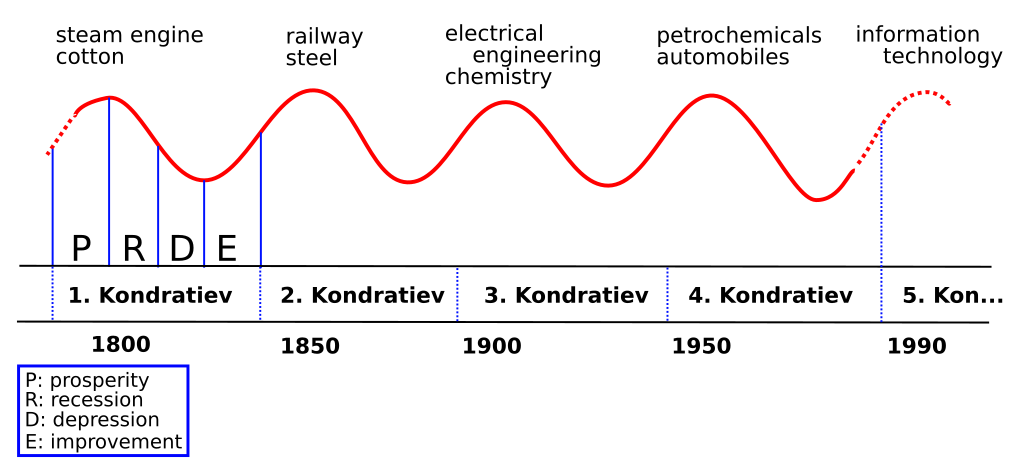
Like most Soviet economists of his time, Nikolai Kondratiev was purged by Stalin in the 1930s, for the crime of predicting the resurgence of capitalism at a time when public sentiment, in the midst of the Great Depression, predicted its end. Nevertheless, Kondratiev’s predictions have mostly held true, and today we find ourselves in the midst of a terminal B-phase, in what followers of the theory of hegemonic cycle would consider to be the end of America’s first hegemonic period.
The 19th century’s hegemonic period saw many shifting allegiances as Britain’s power became increasingly unipolar. As Central Europe united and began to gather its own hegemonic ambitions, Britain was forced to contend with the growing power of several states. These states, most notably Russia, Germany, the United States, and eventually Japan, would follow in the footsteps of Britain’s industrial revolution and seek to challenge the British-led Victorian world-order. Unable to field a large enough navy to win against all four, the British chose to ally with the latter two powers, resulting in British-American rapprochement and the Anglo-Japanese Alliance. When the threat of Russia was blunted by the Japanese during the Russo-Japanese War, Britain found itself with one last remaining would-be contender for its impending hegemonic transition period: Germany. But the war that would break out across the European continent served only to hasten Britain’s decline and improve the American position in the balance of power.
It is around this time that the field of geopolitics began to take shape. Hartford Mackinder, a British geographer who closely studied the work of American naval officer Alfred Thayer Mahan, wrote The Geographic Pivot of History, a book which effectively telegraphed the start of Britain’s second hegemonic transition period. Here, Mackinder described the frailty of the Victorian world-order by geographic means, as the inherent advantages enjoyed by coastal states in the use of sea power was waning. What terrified Mackinder was the advent of the railroad, a technology that revolutionized the transport of goods and threatened to bypass British-dominated sea-trade. Through railroads, a land-based empire could take control of Eurasia, the bridge between two continents, and come to dominate the world. Ostensibly, Mackinder was referring to Russia, but after the Russian Revolution, British fears pivoted to the rapid militarization of Hitler’s Germany.
Mackinder’s work inspired two schools of geopolitics; one of which was formed by the then-liberal powers, and the other of which, consequently, came to be associated with nationalism. Both are rooted in realism, but address the pitfalls created by interstate competition differently. The Anglo-American School of Geostrategy, championed by Mackinder, Nicholas J. Spykman, and George F. Kennan (later Kissinger and Brzezinski would revitalize it in the latter half of the Cold War), was born out of a strategy of containment. To maintain the advantage of the liberal, thalassocratic Britain (later the United States), nations such as Germany and Russia needed to be contained. Their isolation from the world-economy was paramount, as was maintaining a massive advantage in sea power. To prevent a loss of world-hegemony, the liberal world would starve Germany and Russia out of the ability to serve as an economic alternative to the Anglo-American system. Throughout the World Wars and the Cold War, this strategy found mixed success. Still, there is nothing inherently liberal about Anglo-American Geostrategies, being part of the reason why American geostrategy in the Cold War was so often willing to embrace right-wing, even fascist alternatives to even the mildest forms of leftism in the Global South. The Anglo-American school was predicated on a form of ideological conservatism, seeking to create a static world in ideological equilibrium, to minimize losses over the short-term. Though not implicitly liberal, the Anglo-American school was more readily compatible with the rules-based international world order.
The German Organic School of Geopolitics, or geopolitik, was based on a more Darwinist model of how societies work. For Friedrich Ratzel, the father of German geopolitics, nations were a form of organic suprastructure; borders, rather than a static extent of a state’s agreed-upon limits, were subject to the organic needs of the nation’s populace. The concept of lebensraum comes from this idea of organic growth, as do the principles behind the German-Austrian Anschluss. For geopoliticians of the German school, the static adherents to the Anglo-American school were too rigid to grow powerful enough to retain the world hegemony. Karl Haushofer, who would later become a mentor to Adolf Hitler, compared the static nature of the leading Western economies to the dynamic nature of the Japanese Empire, teachings which would influence the Nazi government’s inclination to support Japan. Yet the static United States and static United Kingdom reigned triumphant over the dynamism of German and Japanese fascism, and though the Soviet Union’s foreign policy bordered on a Marxist reinterpretation of the organic growth of communism, Western resilience prevailed.
Why is geopolitics important? Is it an inevitable and recurring Trojan horse by which the liberal world order will be challenged? Are we doomed to listen to realists pontificate on the need for restraint for eternity? Today’s experts on geopolitics stand on both sides, claiming that America must ‘pivot to China’ and abandon Ukraine, striking a deal with the devil and forming a Russian-American alliance in the same vein as Kissinger’s diplomacy with China. This would, of course, be an irrevocable blow to the liberal world-order, and an unseen betrayal of American values that would become as permanent a black mark on the American identity as British colonialism. But it is the view espoused by today’s Elbridge Colby, Vivek Ramaswamy, and a number of other high-profile realists who minimize the importance of America’s commitments to liberalism abroad. Others say that America should return to the Cold War policies of Kissinger and Brzezinski, becoming more open to interventionism regardless of moral or ideological considerations. This, too, is a dangerous trap. If we today bemoan the indifference of the Third World to our pressing issues in Europe and North America, we cannot expect to make the same mistakes of the recent past and hope for a better future. It is such that the Third World, which for the first time since the beginnings of the world-system possesses a voice for which to present its case to the leading powers of the world, merits its own discussion on the universality of Hegelian liberalism.
THE THIRD WORLD
THERE REMAINS an uncomfortable distance between Western liberals and the Third World, particularly on the discussion of Fukuyama’s liberalism and the universalism of liberal precepts. On the liberal side is the patronizing insistence that free-market capitalism is paramount for Third World development, that Third World countries must, for the sake of the world-economy, remain stagnant, and an apologia for the effects of imperialism which have continued in the wake of decolonization. On the other side, the Third World is abound with scathing criticisms of perceived Westernisms, some of which are well-intentioned if not ideal, along with a clear double-standard when dealing with Western issues. Chiefly among them, Third World criticisms of liberal democracy often descend into critiques of unregulated capitalism and former colonial grievances. But much of the disagreement between the West and the Third World stems from the mythological perception of the Cold War as a struggle between two ideologically distinct world-systems, when in reality, the Soviet Union never garnered enough of a global economy to act distinctly from the West.
If the foil of the British world-order was colonialism, the foil of the American world-system is the ardently ideological crusade against developmentalism. The problem with the view of a capitalist and communist bloc in the Cold War was that in the economic sense, neither existed; all countries throughout the Cold War were part of a capitalist world-economy, including the Soviets. Whether their economies were based on free-market capitalism or a socialist command-economy, all states traded in a free market which remained interdependent. Particularly after the 1950s, when the Soviet Union’s economy began to peripheralize as a supplier of raw resources to the European Union, the idea of a ‘capitalist’ and ‘communist’ world-economy was no more than an illusion. Yet even still, the United States denounced and deposed countless policies pursued by so-called socialist leaders, many of which were once American policies during the industrial age.
Under Wallerstein’s world-systems approach, the nations of the world can be divided between core and peripheral states. The semi-periphery, rather than a distinct place, is a process by which a core or peripheral state pursues core or peripheral policies in an effort to change its position. This is a far better interpretation of the Cold War than ‘capitalist’ or ‘communist’, and a far better way to interpret the modern world than ‘left’ or ‘right’. If a proposed policy is likely to lead to increased infrastructure, state capacity, and centralization, it is likely a core process, whereas peripheral processes erode state power, encourage devolution, and promote more reliant economies.
What inspires a country’s politicians to pursue core or peripheral policies? Both processes are inspired by a desire for higher recognition, but for core processes, the desire is usually as part of the collective wishes for national recognition, whereas peripheral processes are often pursued to maintain domestic or even personal recognition. Both are products of megalothymia, or the desire for greater recognition. But one is channeled through a demand for national recognition, whereas the other is not.
It should come as no surprise, then, that the Third World countries of the 20th century, which have succeeded the most in pursuing core processes, are countries where a strong national identity could be established. In contrast, it is why regions such as Africa, where developmentalism has largely failed, remain stagnant. On the one hand, the decision by sub-Saharan African nations to inherit their colonial boundaries and prevent an inevitable period of bloodshed is a heroic and unprecedented accomplishment in the spirit of world peace. On the other hand, the lack of nationalism among African states is part of the reason core processes have been so difficult to attain. Of these states, the most successful (Nigeria, Ethiopia, Kenya) are states that have developed some form of national identity. Pan-Africanism, as an ideology without a state (or even a proper confederation), cannot coordinate this desire for recognition into meaningful core processes. Nor are core processes easily attainable in postcolonial societies with national identities, such as Cuba and the Sahel, where the explicitly anticolonial national identity condemns many of the core processes that could elevate the conditions of their citizenry.
How do we inspire nationalism in postcolonial states that does not engender a hatred of Western core processes? In East and Southeast Asia, countless examples exist to provide a model for development. Neither Vietnam, South Korea, nor Singapore forgot the horrors of colonialism, nor did they entirely shed the ideology of Marxism, in the case of the former. Yet they have succeeded in rapidly developing through the adoption of core processes from the Western world. The marriage of liberalism and the Third World will not be an easy one. In particular, the West must learn to abandon the idea of Western exceptionalism; whereas liberalism’s past can be found predominantly in Europe and North America, its future is inevitably global. Mandela must become as indispensable to our understanding of liberal democracy as Lincoln.
THE END OF THE CYCLE
AS AMERICAN liberalism recedes into a sea of populism, the very elements of our country that make it so exceptional, the belief that anyone from any corner of the world can become an American, are being eroded. Duly note that even without this principle, the United States is likely to remain the leading contender for the position of liberal hegemon. But conceding multiculturalism to nativism undermines an unbelievable advantage the United States has, opening the doorway for other contenders. If Xi were to die in the next five years, and like Mao, be replaced with a liberal-minded reformer, a serious potential for a Chinese century would emerge. If European bureaucrats, as stagnant and dogged by their own populisms as they are, were to properly federalize the European Union into a world superpower, the American century would be almost certainly over. Neither of these events is likely, but that is exactly why the present scenario is so dangerous. If American liberalism continues to recede without serious changes in the organization of other world powers, we may experience a ‘lost century’ for liberalism, during which the leading liberal world-order is, for the first time, more illiberal than the previous one. Today, this is the likeliest scenario we face.
Even still, such a disastrous hundred years would only further demonstrate the finality of the end of history. In Fukuyama’s words, if the West grew bored with the end of history, history could start anew. But it would be a clear step backwards into the past, not the opening of a new path on a trail with a different ending. It would be a product of Western hubris, over reliant on the dangerous fantasies of realist foreign policy and drunk on the lies of modern populism.
How does America emerge from our descent into illiberalism? Liberalism can only survive and progress through the combination of effective domestic and foreign policy. The former, under the recent work of Derek Thompson and Ezra Klein, has found its slogan: Abundance. It is the clearest possible rebuke of peripheral processes that have dogged the American economy since the 1950s, on behalf of both the left and the right. Abundance has the potential to form a pluralist, moderate coalition of center-left and center-right liberals alike, who feel increasingly homeless in the parties of MAGA and the DSA. Deregulation, infrastructure spending, and effective governance are simple positions that can emancipate America from decades of stagnation. There is nothing overtly complex in the Abundance agenda.
Similarly, our foreign policy must be analyzed through a lens that acknowledges failures from both the left and the right. Many Democrats who today decry the Trump administration’s termination of USAID would balk at Clinton’s gutting of the State Department in the late 1990s, including the dismantling of USAID’s partner organization, the United States Information Agency (USIA). Inspired similarly by a geopolitical urge to preserve the balance of power in the absence of an ideological opponent, the Clinton State Department left U.S. foreign policy unprepared for the September 11th attacks, following which many of the duties of the State Department were overtaken by the Department of Defense. In many ways, nothing about the world changed after 9/11, but the unprecedented militarization of American foreign policy forced the world to change in response. Like British naval rearmament in the 1900s, the hegemonic transition period became a self-fulfilled prophecy of realist preparation for armed conflict that engenders the same war it seeks to prevent. Whereas pacifism is naïve and deterrence ideal, the zealousness with which the U.S. militarized its diplomacy forced other nations to act in kind.
The Trump administration’s State Department cuts are akin to beating a dead horse and lighting it on fire; as significant as the damage caused will be, returning to the status quo in a subsequent Democratic administration will not be enough to address our foreign policy woes. Like the Kennedy reforms of the 1960s, which turned the State Department from a glorified gentleman’s club to the most influential organization for public diplomacy in the world, we must seek our own form of Abundance in foreign policy. Maximalism, insofar as a critique of the Bush administration’s failed ideological crusades, is an inherently militarized doctrine. If there is to be a maximalist diplomatic doctrine for American foreign policy, it must redress the inadequate conditions of the State Department, resume control over discussions regarding foreign policy, and take a dominant role over the Department of Defense. These steps, and more, are necessary to engage in the same kind of diplomacy that rallied global consensus in favor of the United States during the Cold War. Anything less is an unserious solution to the endemic problem of America’s horrible reputation abroad, which no modern administration has seriously endeavored to fix.
Though the contenders to a liberal hegemony remain uncertain, we can be sure of which nation aspires to be the dark horse of illiberalism. Russia, through the neofascist ideology of Eurasianism, has revived the German Organic School of Geopolitics under a doctrine of global domination. From the methodical approach of Aleksandr Dugin to the insane ramblings of Vladimir Zhirinovsky, Russian nationalists envision a Russian world from Berlin to Juneau, from Murmansk to Karachi. It is an insane and dystopian vision for humanity, where the world-system falls once more under the control of Wallerstein’s world-empires, vestiges of the past incompatible with the world-economy. There is no limit to the Russian state’s ambition for conquest, and it is precisely due to this aggrandized sense of megalothymia that Russia’s hegemonic ambitions will continue to fail, though their participation in the hegemonic transition itself is unavoidable.
It is thanks to its interdependence in the world-economy that China, the most presently feared adversary of the United States, is unlikely to launch a serious illiberal hegemonic bid. Decoupling, spurred on by trade wars initiated by the United States, may raise this possibility. But it is Russia, not China, whose sanctioned war-economy has had three years to prepare itself for the creation of an alternative economic bloc, similar to that which Hitler’s Germany and Stalin’s Russia tried (and failed) to build as a part of an alternative world-order. The present world order, ostensibly to Beijing’s advantage, continues to be far more preferable than the nightmare of the Russian-led world order.
Other wild cards exist, if not as contenders, as crucial to determining who may eventually win the coming transition period. Britain, Japan, South Korea, India, Brazil, and Türkiye have all emerged as middling foreign powers; not quite ready to mount a hegemonic challenge but able to sway the balance of power significantly one way or the other. So too have nations like Ukraine and Palestine, as symbols of global resistance and ideological conflict, emerged as unlikely influencers, whereby association with them or their opponents may gain or lose the trust of countless nations unsure of where to throw their support. Like every previous hegemonic transition, consensus is never equal; the support of India bears far more weight than the support of Sri Lanka. But the UN’s existence as a stage where all votes in the General Assembly are counted equally is an unprecedented step towards a literal sense of pluralism among nations.
THE LAST STATE
Today, we have reached a period in history where successive cycles of conflict and hegemony are both increasingly liberal and increasingly devastating. Each subsequent hegemonic period operates on a larger scale of capital accumulation, population demographics, and more destructive weaponry. Subsequently, the stakes of each terminal B-phase have risen significantly. Now, nuclear weapons, aerial and satellite sensing, drones, and AI-powered weaponry have completely changed the landscape of war. A clash between the United States and any hegemonic contenders, wherever they may arise, would be as pyrrhic a victory for the winner as the World Wars. We find comfort in the knowledge that the long course of history favors the ascendance of the most liberal hegemon possible, whether the United States or one of the many contenders in the coming hegemonic transition period. But the question remains: to what end?
We can identify two immediate scenarios.
The unification of the world’s states under a single liberal democratic entity, whether a confederation or a unitary state, such that there remains no potential for anarchy in world affairs.
The destruction of the world’s civilizations to a point of prolonged or no recovery, by which point societies collapse and the world-system no longer exists.
Both are endings of equilibrium, though one is far more violent than the other. Luckily, the framework for the first scenario is in place; the United Nations, through a process of long-term reform, can become an instrument by which to end the hegemonic cycle. This, then, would mark the beginnings of humanity as one global civilization, whereby sectors of varying autonomy continue to exist, but governance and national identity share a common source. Doing so would exhaust all outlets of megalothymia, save for intersectoral economic competition. There is no simple roadmap by which such a process of reform could begin, nor is it likely anyone reading this essay will see such a state in their lifetime. But it is one of two decisive conclusions to the hegemonic cycle, until such a time as multiple independent states re-emerge in the long run of humanity’s ascent into interplanetary or interstellar civilization.
The latter scenario needs little explanation. If a hegemonic transition period were to escalate to the point of mutually assured destruction, human society could be damaged to a point of no return. Of course, if any humans survived at all, the hegemonic cycle would eventually resume. Although the destruction of civilization, as an apocalyptic event for the human species, would likely influence the postapocalyptic hegemonic cycle in unpredictable ways, it is unlikely that the desire for equal (or greater) recognition would have left humanity.
There is, of course, the possibility that the hegemonic cycle does not continue at all. This is the view espoused by Peter J. Taylor, who considers the flattening effects of globalization to hallmark a permanent end to the hegemonic cycle, and perhaps an end to the global bias towards liberalism. If the world has become so interdependent as for the natural anarchic state of nations to no longer possible, then perhaps there is no need for a modern conception of world-order. Key here is not merely interdependence in trade, but interconnectivity as a result of the World Wide Web. As travel and social networks erode the traditional barriers to communication, perhaps states will eventually recede into the background, replaced by multinational economic players such as corporations and trade organizations. A softer version of the first scenario, it would likewise result in an end to national megalothymia, the ‘depersonification’ of nations, and a universalization of equal recognition in the long-term.
If you are alive today and young like I am, there is no need for pessimism. The years ahead may be remembered as a period of violence and poverty, but perhaps more influential than any other decade of the 21st century. It is now that the world’s centennial realignment takes place, and there is no greater gift to the generations to come we may give than to advance the banner of liberalism as far as we can in our lifetime. Fukuyama once lamented the end of history, signifying the end of one’s chance to risk their lives for a purely abstract goal, the same motor of human dignity and desire that has led every successive generation of people towards the present. Here, perhaps, he was wrong. So it seems that the end of history stands as an ever-burning beacon, closer in sight with each passing day, to which we in today’s time strive towards all our lives before passing the baton to our children’s children.